
Why One Session Never Tells the Whole Story
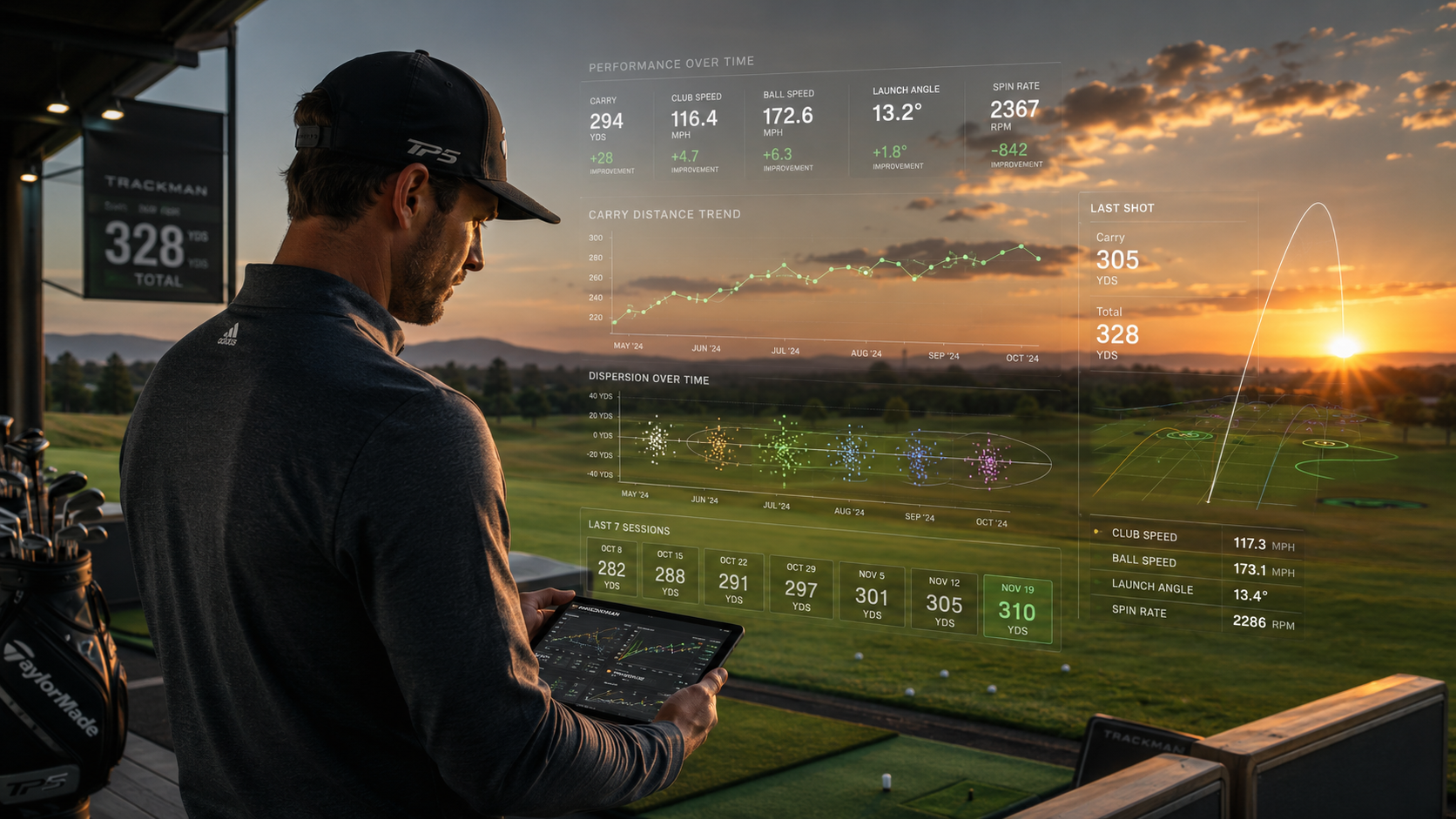
We've all had that moment on the range: you fire up your launch monitor, hit a few shots, and suddenly your entire golf identity feels like it's up for debate. One day you're compressing it like a tour pro, and the next your spin is up, ball speed is down, and dispersion looks like you're painting abstract art across the grid. That's the trap. A single session can feel emotional, urgent, and definitive — but when it comes to golf practice tracking, one session is almost never the truth. Real progress shows up when you look at launch monitor over time patterns, not single-day snapshots.
As golfers, we crave certainty. But golf doesn't hand us certainty — it hands us patterns, nudges, and long-term trends. When we let one session define us, we chase noise instead of listening to signal. And the signal only shows up when we start tracking golf progress data across 25+ sessions instead of just reacting to the last bucket of balls.
Why One Launch Monitor Session Can Mislead You
A launch monitor is an honest friend, but honesty can be misleading when viewed through too small a window. Think about the variety inside your golf life: sleep, stress, weather, warm-up, swing thoughts, the type of ball you hit, the clubs you brought, the turf beneath your feet. All of these variables move your numbers — sometimes by a little, sometimes by a lot.
The Emotional Meaning We Attach to Numbers
When golfers overreact to a single bad session, it usually comes from a place of caring deeply. We want to see ourselves improving. We want evidence that the work we're putting in is paying off. But the more attached we become to moment-to-moment numbers — ball speed, carry distance, spin rate — the easier it is to misinterpret them.
If you normally hit your 7-iron 145 carry but see a few shots at 135 during a session, it’s tempting to think something’s broken. But maybe your timing was off. Maybe you were cold. Maybe your warm-up was rushed or you slept poorly. A single session can't tell you whether that drop is real or just noise. This is why golfers need to build their practice identity around golf session trends, not isolated readings.
Why Amateur Swings Vary More Than You Think
Most amateurs underestimate how much natural variation exists from one swing to the next. Even solid mid-handicap golfers can see:
- 5–7 mph ball speed variance within a single club
- 20–35 yards of dispersion left-to-right
- 5–10 degree changes in face-to-path
- Differences of 300–800 rpm of spin
If the swing itself has built-in variability, any given session will reflect that variability. That’s not failure — that’s golf. The goal is not to eliminate variation; the goal is to understand it.
What Trends Across 25+ Sessions Reveal
This is where the game changes. When you stack sessions — when you commit to using your launch monitor sessions consistently — you start seeing the patterns that actually matter. This is where your game’s true story emerges.
Trend #1: Directional Patterns and Dispersion
It’s not the shot you hit last Tuesday that matters — it’s the cluster of shots you hit over the past five weeks. Over 25+ sessions, you might notice your driver pattern living slightly right of target, or your wedges tending to pull left when you get quick.
Dispersion trends show you:
- Your true miss pattern (not the one you imagine)
- How consistent your face control really is
- Whether your swing changes are stabilizing or drifting
When you view your shot analytics across many sessions instead of reacting to one, you start to understand who you are as a ball-striker — not who you were for 20 minutes on a windy Wednesday evening.
Trend #2: Distance and Ball Speed Stability
The biggest trap golfers fall into is assuming distance changes are meaningful. If your 7-iron suddenly appears 10 yards shorter, it's easy to panic. But across 25+ sessions, you’ll see a far more trustworthy story.
Multi-session tracking helps reveal:
- Whether your average ball speed is trending up or just fluctuating normally
- If your club gapping holds steady over time
- Whether recent lessons or drills have improved efficiency
Golfers often discover their distances are far more stable than they felt — or that they’ve been undervaluing real gains hidden inside the noise.
Trend #3: Contact Quality Over Time
Strike quality is rarely a straight-line improvement. It’s more like a heartbeat monitor — up, down, flat, jump, dip, then slowly trending upward. Over 25+ sessions, patterns emerge:
- Toe strikes on longer clubs
- Fat shots when tired
- Thin wedges when rushing
- Improvements that show up first in shorter irons
You learn what causes contact issues, not just that they happened. The data helps you coach yourself more effectively.
Trend #4: Consistency Metrics
When golfers think consistency, they often only think "hit it the same every time." But launch monitor data lets you measure consistency in ways that are both actionable and encouraging:
- Standard deviation of carry distance
- Average dispersion circle width
- Ball speed variation
- Spin rate clustering
Tracking these over time gives you a sense of whether your game is getting tighter. Often, what feels like stagnation is actually subtle consolidation — your shot patterns tightening before your scoring drops.
Why 25+ Sessions is the Magic Range
Twenty-five sessions is a meaningful psychological and statistical threshold. Statistically, it’s enough data to smooth out the noise. Psychologically, it’s enough time to see who you are over a stretch of golf, not a moment.
Across 25 sessions, you’ll see three distinct things:
1. Your Baseline
Your real numbers — not your best, not your worst — your true playable game. This helps with club selection, game planning, and expectations on the course. When you know your real carry distances, you play smarter golf.
2. Your Progress Arc
Trends become unmistakable. Maybe your driver ball speed is creeping upward. Maybe your wedge dispersion is steadily tightening. Or maybe your long irons show a pattern of inconsistency you never noticed before. Long-term data builds confidence because it shows where you're actually improving.
3. Your Seasonal Patterns
Golfers are seasonal creatures. Your swing feels different in winter vs. summer, early season vs. mid-season. Only long-term tracking golf progress data shows the real rhythm of your game.
What’s Noise vs What’s Signal
Noise (Ignore This)
- A dip in ball speed during a single session
- An unusually high or low spin reading
- A sudden distance drop on one club for one day
- A cluster of misses early in a warm-up
- One great or terrible session
Signal (Pay Attention To This)
- Your 7-iron dispersion trend over 25+ sessions
- Average carry distance moving up or down for 3+ weeks
- Consistent directional bias (left, right) across many sessions
- Contact quality improving slowly but steadily
- Tighter distance and spin consistency
The goal is to stop reacting emotionally to the noise and instead build confidence from long-term signal.
How MindSetPlay Helps You See the Long-Term Truth
Our platform is designed for this exact purpose — helping golfers get past the trap of session-to-session emotions and see the full picture of their development.
You can review your past launch monitor sessions to see how your game evolves over time. Your shot analytics highlight patterns in distance, dispersion, contact, and consistency, helping you focus on what matters. And with AI insights surfacing trends automatically, you don't have to guess what's noise and what's signal — the platform shows you.
Bringing It All Together
Golf improvement doesn’t live in one session — it lives in the patterns across many. The more consistently you track your practice, the more confident you become. Not because every day is perfect, but because you start to understand your game at a deeper level. You stop chasing the latest miss and start trusting the long-term signals.
That’s the real power of golf practice tracking, of looking at your launch monitor over time, of using long-term tracking golf progress data. It builds clarity. It builds resilience. And most importantly, it builds self-belief — because finally, you’re not guessing. You’re learning from your own patterns.
Keep stacking sessions. Keep reviewing trends. Keep giving yourself credit for the long-term work. That’s how your game transforms.